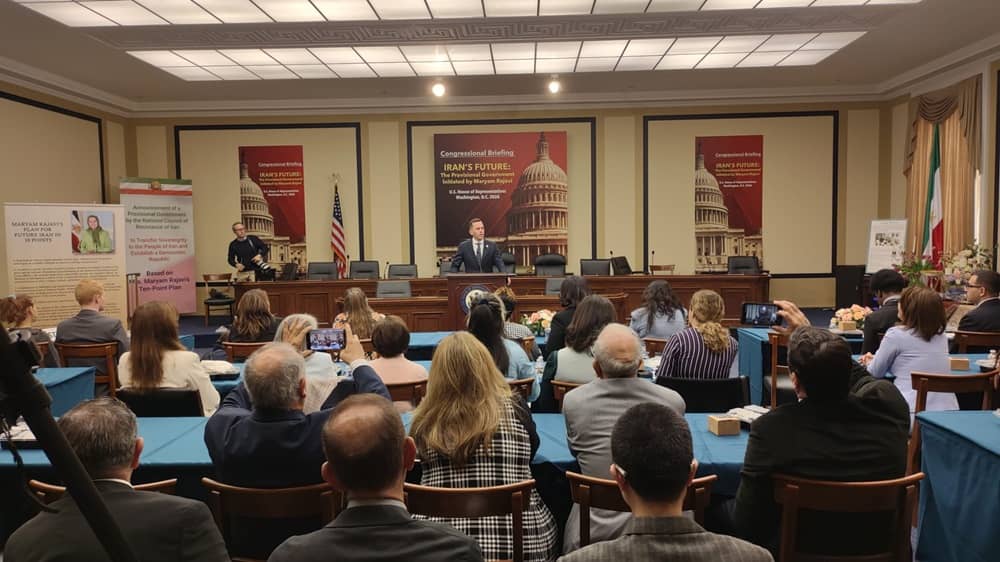
On March 26, 2026, the Organization of Iranian American Communities (OIAC) held a congressional briefing on democratic transition in Iran and the announcement of NCRI’s provisional government. At the event, U.S. lawmakers and NCRI President-elect Maryam Rajavi said Iran’s future should be decided by the Iranian people.
They voiced support for House Resolution 166 and the NCRI’s Ten-Point Plan. They also called for a democratic, secular, and non-nuclear republic. Speakers stressed free elections, self-determination, and support for the Iranian people. Congress members also backed “organized resistance” and the policy of “no war, no appeasement,” while several participants explicitly rejected a return to monarchy and said the way forward was “the ballot box.”
Dr. Ramesh Sepehrrad, Iran policy analyst and OIAC board member, opened the event by saying the gathering was also honoring Nowruz, while acknowledging “a difficult year for the Iranian people,” citing “the massacres that were committed by the regime in the streets” and “the war and the destruction that the Iranian people are facing.” Dr. Sepehrrad said the purpose of the briefing was “to discuss where Iran is heading” and “define a roadmap that would deliver democracy, freedom, and a non-nuclear secular Republic of Iran.”
Mrs. Maryam Rajavi, President-elect of the National Council of Resistance of Iran (NCRI), said in a message to the briefing, ‘The solution to the crisis in Iran is the overthrow of the regime, which can only be achieved by the Iranian people themselves through their organized resistance.”
She said, “The answer lies with the Iranian people and youth: The Resistance Units and the Liberation Army,” and described that resistance as relying on “the experience and commitment” of the PMOI/MEK, which she said “has fought against this regime for 47 years.”
Mrs. Rajavi stated the NCRI “reject both the former monarchical dictatorship and the current religious tyranny,” adding that “the slogan of the Iranian Resistance and the provisional government is peace and freedom.” She also said the Iranian Resistance “does not ask for boots on the ground, money or weapons from foreign countries,” while calling for recognition of the NCRI’s provisional government, technical support for internet access, and “the expulsion of agents of the regime from U.S. soil.”
Citing the liberation of Iran, Rep. Brad Sherman said, “We have never been closer,” and argued that “this regime cannot be reformed, and it needs to be replaced.” He said House Resolution 166 expresses support for “a democratic secular non-nuclear Republic of Iran,” and called for more pressure on Tehran and its security forces. Rep. Sherman also argued that “our number one tool is the truth,” saying, “We have to use the internet, and we have to go back to old fashion, we need to be broadcasting in Farsi.” He also pushed for tougher international action, saying Washington should ensure that “our allies join the sanctions” and press partners to “finally sanction the IRGC.”
Rep. Tom McClintock said, “The hour of Iran’s redemption has arrived,” and argued that “Resistance groups throughout Iran are prepared to take up arms against this regime and to finish the job.” He urged support for those forces, saying they need “the full moral and material support of the United States.” McClintock said the NCRI’s Ten-Point Plan “offers a credible democratic pathway for Iran’s future, upholding human rights, pluralism, and the rule of law.” He also said “this already crippled and withered regime must be ripped out by its roots” and pointed to “the many resistance groups” and “these thousands of small cells across Iran” that, he said, had “awaited the arrival of spring.” At the same time, he said, “It will ultimately be up to the people of Iran to decide their future democratically.”
Rep. Randy Weber repeatedly invoked the Ten-Point Plan, listing “rejection of the absolute clerical rule,” “freedom of speech,” “freedom of political parties,” “freedom of assembly,” and “freedom of the press and the internet,” as well as the “dissolution of the Iranian Revolutionary Guard Corps.” He said, “We’re behind this movement. We’re behind the Ten-Point Plan,” and added, “This is not anti-America. These are people crying out for their God-given freedoms highlighted in Maryam Rajavi’s Ten-Point Plan for the future of Iran.” Weber also said, “The Iranian regime has been in business too long” and “it is time that they go.”
Rep. Deborah Ross said she was “a proud original co-sponsor of House Resolution 166,” which she described as outlining “the Ten-Point Plan, a roadmap for a free, secular, and democratic Iran grounded, grounded in human rights, gender equality, and the separation of religion and state.” She said that while Congress has shown bipartisan support for “the Iranian people’s aspirations,” “there’s so much more work to be done getting rid of the regime.” Rep. Ross added that “Iranians are courageously leading a democratic movement themselves” and said she was working “to advocate for an end to this war in a way that the people of Iran are free and supported” and able “to form their own new democratic regime.”
Rep. Glenn Grothman said the key issue was not simply a change of faces in Tehran, but a change in the nature of the government itself. “As long as they have a government that says we are going to build nuclear bombs and we are also going to destroy the United States and destroy Israel,” he said, Iran would remain both repressive at home and dangerous abroad. Rep. Grothman urged supporters to tell members of Congress that “when this war wraps up, we want Iran to have a government” with “Western style freedoms,” including “freedom of speech” and “freedom of religion.” He also said, “we have to make sure there’s always internet for people,” and argued that any eventual settlement should ensure “a Westernized and free country.” Rep. Grothman said Iranians “want and deserve” that form of government and warned against a situation in which “we just have another 30,000 protesters die and nothing for it.”
Rep. Tim Burchett said “the people of Iran deserve freedom” and endorsed Mrs. Rajavi’s political program, saying “her roadmap sends a clear message that we do back a transition to a republic based on the will of the people in free elections.” He also said, “no war and no appeasement” and argued that “we should recognize the rights of the people and organized resistance to bring change about.” Rep. Burchett added that “what bothers me is the people and the mistreatment of the people,” and said he hoped Iranians would know “that America backs their will for freedom.”
Rep. Rob Menendez thanked the audience and stressed that “what I’ve said from my time in office, what I will continue to say, is that the future of Iran will be determined by the Iranian people.” Rep. Menendez described “their right to a free Iran, one in which they can prosper and live the lives that they have so eagerly hoped that they would one day have the opportunity to live.” He added, “That future seems near,” and said he was “eager to see what is ahead for Iran” and “what is ahead for the Iranian community here in the United States.” He closed by telling the audience, “In everything we do moving forward, you will have my support and partnership.”
Rep. Christian Menifee linked his remarks to the late Sheila Jackson Lee, saying she had long stressed “the importance of supporting democratic movements in Iran.” He said that means “ensuring that organic movements are supported” and working “to stop the repression that we have seen from this regime.” Rep. Menifee added that his commitment is “to support folks who are fighting for democracy in Iran,” while also “opposing any efforts that would harm civilians in Iran,” and ensuring that the U.S. approach is “to support people on the ground and not to try to force that change on them from abroad.”
Rep. John Moolenaar said it was “a challenging time for the people of Iran” and spoke of hearing from friends in the United States “who have loved ones” in Iran and “such hopes for the future.” He said, “My hope is that the people of Iran will experience the freedoms that we enjoy here in the United States,” adding that “Iran has tremendous potential which has really been discouraged these last 47 years.” Rep. Moolenaar also welcomed discussion of “vision and ideas for the future,” saying “it’s important that we put those ideas out there that people have a chance to digest and really collectively think about the future of Iran.”
Editor’s Note: As one of the most steadfast organizations in the overseas Chinese democracy movement, we closely follow the situation in Iran and firmly support the Iranian people’s struggle for freedom.